Self-Catering Holidays in Malta: What They're Really Like
Self-catering in Malta is something we know from the inside: our townhouse in Senglea is a self-catering house, and after a few hundred stays we have a clear view of what works and what catches people out. The short version: Malta suits a self-catering holiday unusually well, because the island is compact, the food shopping is good and eating out is easy enough that a kitchen never becomes a chore. This guide covers why self-catering makes sense here, a few practical things to know, where to shop and what to buy by season, what to ask a host before you commit, the apartment-versus-townhouse question and where to base yourself. We finish with a plain description of our own place, so you can judge whether it fits.
Is Malta good for self-catering?
Yes, and for reasons specific to this island. Malta is small: even the far end of the island is a bus ride rather than a road trip, and from the harbour towns Valletta is a ten-minute ferry ride. You are never far from a shop, a bakery or a restaurant, so a kitchen is a choice rather than a necessity. You cook when you feel like it and walk out when you don't.
The point of a kitchen here is not three meals a day. It is breakfast on a terrace before the heat builds, or a lunch of bread, tomatoes and ġbejniet (the small Gozitan cheeselets) that takes no effort. It is long evenings with a bottle of local wine and a view, when nobody wants to go looking for a table. Maltese produce rewards simple cooking, which is what a holiday kitchen is for.
It suits three groups particularly. Families with young children, who need breakfast at seven and supper at six whether or not a restaurant agrees. Groups of friends or two families travelling together, for whom one house with one table beats a row of hotel rooms; we have written separately about family and group stays in Senglea. And anyone staying longer than a week, because nobody wants restaurant food fourteen nights running, and by day nine a washing machine becomes the most valuable thing in the house.
A few practical things to know before you arrive
None of these are problems, just the things worth knowing before the first evening.
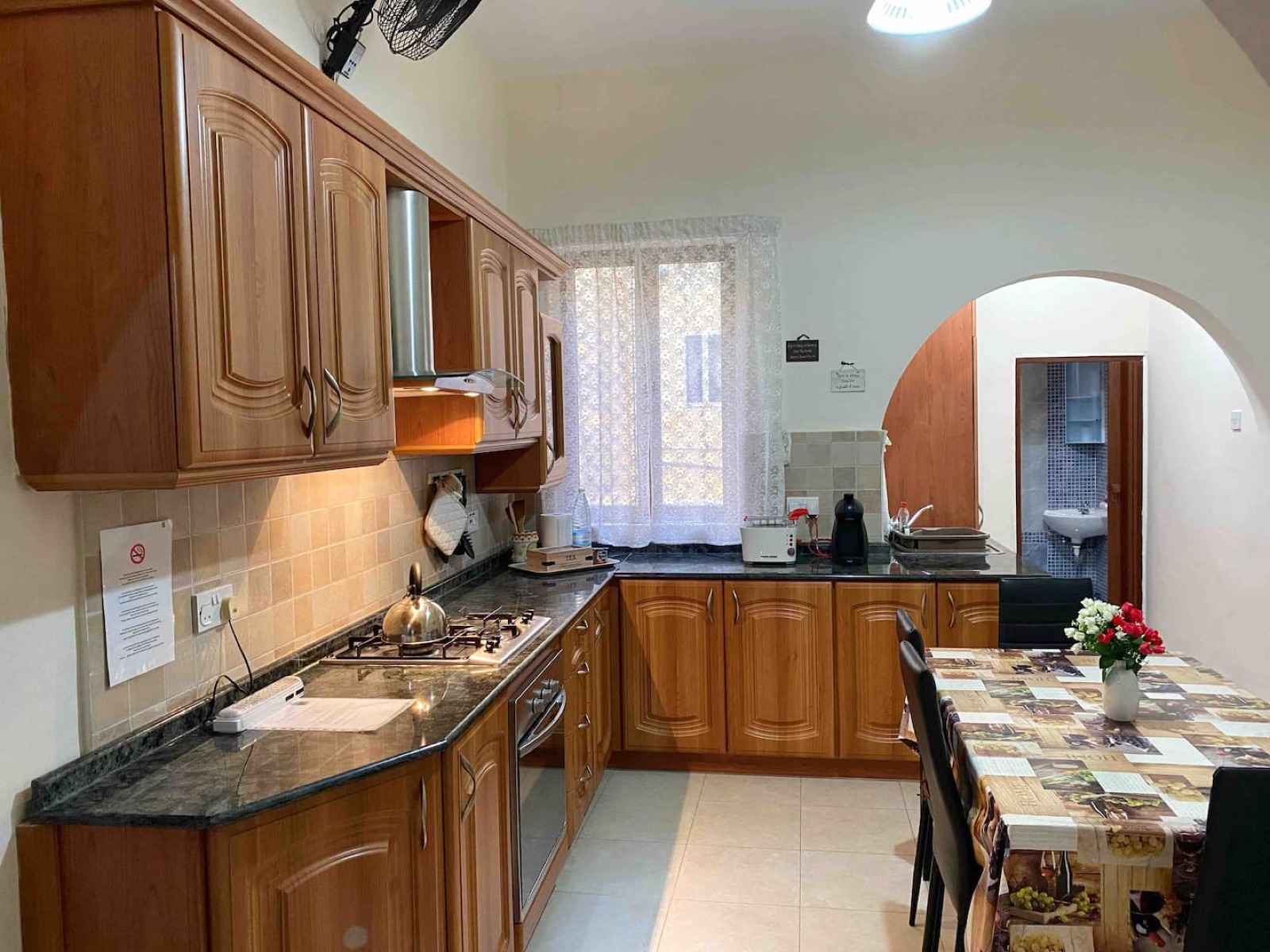
- Kitchens vary, so ask. Some holiday apartments have a compact kitchen with a couple of rings and a microwave, so check what you are getting. Ours is a big, full-size kitchen with an oven, gas hob, fridge and freezer, and plenty of room to cook properly for six.
- Gas hobs are the norm. Many Maltese kitchens cook on gas, which heats quickly and is easy to use. If you have only used induction, the host's house notes will cover it.
- A first-day shop is part of the fun. We leave coffee and tea to get you started; pick up the rest, washing powder included, at the local grocer on your first walk out.
- Recycling is door to door. Household waste goes out in colour-coded bags on set days, so ask your host which bag goes out when and you are set.
- Bottled water is the local habit. Tap water is treated to drinking-water standards, but much of the supply is desalinated and the taste shows it. Many people here, ourselves included, drink bottled water or use a filter jug, and use the tap for cooking, the kettle and washing up.
- Summer heat changes how you cook. In July and August nobody wants the oven on for an hour. Think grilled fish, salads, cold cuts and bread, eaten late on the terrace once the air cools.
- Townhouses have stairs. Traditional houses are built upwards, with stone staircases. Ours has them too, with hand railings, and no lift, so if anyone in your party struggles with stairs, ask every host directly.
What are the downsides of visiting Malta as a tourist?
People ask us this, and it affects where you base yourself, so here are the things visitors most often grumble about. Summer is hot and crowded; in July and August there are queues at the main sights. There is a great deal of construction in the busier towns, and the resort strips of Sliema, St Julian's and Buġibba feel more built-up than the photographs suggest. Traffic is heavy, driving is on the left and parking is scarce, which is why many visitors are happier without a car, as we explain in our guide to staying in Malta without a car. Sandy beaches are few and mostly in the north; much of the swimming is off rocks. Buses are cheap but fill up in summer.
None of this stops us loving the place. It does mean that your choices matter more here than almost anywhere else. Pick a quieter, older base, time the trip for spring or autumn (our month-by-month guide covers the calendar) and rely on the ferry and your own feet rather than a hire car.
Food shopping in Malta: where to go and what to buy
Shopping on a Malta self-catering holiday is a pleasure, provided you know where to look.
Supermarkets. The larger supermarkets sit in the bigger towns and on the edges of villages, and stock everything you would expect at home, including familiar brands. Reaching the biggest usually means a bus or taxi ride; smaller branches sit in most town centres.
Corner shops. Every neighbourhood has its grocer, usually tiny, usually run by someone who knows everyone. This is where you buy milk, bread and eggs at eight in the morning in your flip-flops. In Senglea there are small shops and a pharmacy within moments of our door.
Bakeries and pastizzi. Maltese bread (ħobż tal-Malti) is a crusty sourdough loaf and the ftira is its flatter cousin; both are best the morning they are baked. Pastizzi, the flaky diamond-shaped pastries filled with ricotta or mushy peas, come from the pastizzerija and make an easy breakfast or afternoon snack. Listen for the bread van's horn too; in many streets it still does its rounds.
The Sunday market at Marsaxlokk. The fishing village in the south-east is best known for its Sunday-morning market along the harbour; check it is on before you make the trip: fish straight off the boats, fruit and vegetables, honey, and a good deal of souvenir stock you can walk past. Go early, buy fish for that evening and have a coffee beside the painted luzzus. It is a bus or taxi ride from the harbour area; our guide to getting around Malta by bus and ferry explains the network.
Local produce by season. Winter brings oranges, lemons and cauliflower; spring means broad beans, artichokes and the first strawberries from Mġarr; summer is tomatoes, melons, figs and peaches; late summer and autumn bring prickly pears, pumpkins and lampuki, the dorado everyone waits for. Year-round, look for ġbejniet, sun-dried tomatoes, capers, local honey, Maltese sausage and kunserva, the thick tomato paste that goes on bread with olive oil.
What a good self-catering place includes, and what to ask
Listings use "self-catering" and "fully equipped" loosely. Before you commit, ask these questions.
- Oven, or hob only? Plenty of apartments have two rings and a microwave. If you want to roast or bake, ask specifically for an oven.
- Fridge and freezer. A freezer compartment matters in summer, for ice, market fish and leftovers.
- Washing machine, and is detergent provided? Essential for families and for anything over a week. Many hosts, ourselves included, provide the machine but not the detergent.
- Wi-Fi. Ask whether it is included and reliable enough for video calls, especially if anyone is working.
- Air conditioning and heating. The question most people forget. Every room or bedrooms only? Included or metered? Heating in winter? Ours is in the bedrooms only, pay-per-use, and doubles as heating; fans are free. Arrangements differ widely, so ask rather than assume.
- Towels, linen and the basics. Confirm bed linen and bath towels are included, and ask about beach towels, coffee and tea, and a starter supply of toilet roll and soap.
Stairs and access, parking, licensing and cancellation terms apply to any Maltese holiday rental, not just self-catering ones, so rather than repeat that checklist here we have put it in our guide to short lets in Malta.
Self-catering apartment or whole townhouse in Malta?
Much of the self-catering accommodation in Malta is apartments: modern blocks in Sliema, St Julian's, Buġibba and Mellieħa, often with a balcony and a short walk from the sea. For a couple on a week's holiday who want the seafront, that is a sensible choice, and there is a great deal of it.
A whole townhouse is a different proposition. You get the whole building, ground floor to roof, with bedrooms on different levels, more than one bathroom, a kitchen and dining space, and in the good ones a roof terrace that becomes the room you actually live in. It suits six people far better than most apartments, because everyone has a door to close. And it is how people live in the old harbour towns, so you are in a street of neighbours rather than a block of other visitors.
The trade-offs are real. Townhouses have stairs, and usually no lift. They are older buildings, so expect character over polish: stone walls, high ceilings and the odd quirk. Parking is on the street. If any of that bothers you, an apartment in a newer block will serve you better.
What is the nicest part of Malta for a self-catering holiday?
We are often asked what the nicest part of Malta is, and the honest answer is that it depends what you want. Valletta is the grandest and most central, with everything walkable, at the cost of crowds. Sliema and St Julian's are where the apartment blocks are, with the seafront promenade and the nightlife, and the least old-Malta character. Mellieħa and the north have the sandy beaches and a resort feel. Gozo is countryside and quiet, a ferry away.
Our own choice, and not only because our house is there, is the Three Cities: Senglea, Birgu and Cospicua, across the Grand Harbour from Valletta. They are lived-in, walkable, well served by ferry and bus, and quiet at night. For self-catering specifically, they have the shops, bakeries and waterfront restaurants a kitchen-based holiday needs within a few minutes on foot.
Rather than repeat ourselves: where to stay in Malta covers the whole island, where to stay in the Three Cities covers this side of the harbour, and our introduction to the Three Cities explains what they are actually like. If the cool months appeal, our Malta in winter guide covers long, quiet stays out of season.
Our kitchen, and the roof terrace over the Grand Harbour
Here is our own place, described plainly. It is a traditional Maltese townhouse in Senglea, the fortified 16th-century city across the Grand Harbour from Valletta. The house has three bedrooms (two with double beds, one twin with two single beds), sleeps six, and has two and a half bathrooms.
The kitchen is big and full-size: oven, gas hob, fridge and freezer, with crockery, glasses and cutlery, and a dining table that seats six. We provide coffee and tea, so the first morning is covered before you have found a shop. There is a washing machine; bring or buy your own detergent. Wi-Fi is free. Air conditioning is in the bedrooms only, pay-per-use, and doubles as heating in winter; fans are free.
The roof terrace is the thing guests mention most. It looks across the Grand Harbour to Valletta, and it is where guests eat breakfast, lay out a lunch of bread, tomatoes and cheese, and sit with a glass of wine while the bastions opposite turn gold. Carry a tray up the stairs and dinner there beats most restaurants with a view.
Small shops and a pharmacy are moments from the door, and the waterfront restaurants are five to seven minutes' walk for the evenings you don't cook; the Valletta ferry landing is about fifteen minutes on foot. We have 4.86 from 278 verified guest reviews. Check-in, parking and the full list of walking times are on the house page, and our Senglea guide covers the town itself.
Who it suits, and who it doesn't
It suits couples who want a kitchen and a terrace rather than a hotel corridor, and families and groups of up to six who want one table and separate rooms. It also suits anyone staying a week or more who values a washing machine and a real neighbourhood. It suits people happy to walk: the street is pedestrianised, the nearest point a car can stop is about 70 metres away, and free street parking is nearby, first come first served.
It doesn't suit everyone, and we would rather say so now. There are traditional stone stairs with hand railings and no lift, so the house is not suitable for wheelchair users or anyone who finds stairs difficult. We don't take pets. There is no pool. If you want a modern block with a lift, a pool and parking underneath, Sliema will serve you better.
If you are planning a few weeks rather than a few nights, our guide to short lets in Malta covers longer stays. And if a kitchen, a terrace over the Grand Harbour and a quiet street sound like your kind of holiday, send us your dates and we'll tell you straight whether the house fits.
Frequently asked questions
Is Malta good for self-catering?
Yes. Malta is compact, so a shop, bakery or restaurant is never far away, and the produce rewards simple cooking: bread, tomatoes, local cheeselets, seasonal fruit and fresh fish. Self-catering suits families, groups and anyone staying more than a week particularly well. The only things to plan for are that many people drink bottled water and that summer heat means cooking light.
What are some downsides to visiting Malta as a tourist?
The main downsides are summer heat and crowds, a great deal of construction in the busier towns, heavy traffic and scarce parking, few sandy beaches, and buses that fill up in July and August. Most of these are eased by choosing a quieter, older base such as the Three Cities, visiting in spring or autumn, and relying on the harbour ferry and buses rather than a hire car.
What should a self-catering apartment in Malta include?
Ask whether there is an oven or only a hob, a fridge with a freezer compartment, a washing machine and whether detergent is provided, and reliable Wi-Fi. Ask how air conditioning and heating are arranged, since they are often in bedrooms only or metered. Confirm linen and towels are included, ask about stairs and lifts, and ask the host for their Malta Tourism Authority licence number.
Can you drink the tap water in Malta?
Tap water in Malta is treated to drinking-water standards, but much of the supply is desalinated and the taste shows it. Many residents, ourselves included, drink bottled water or use a filter jug, and use the tap freely for cooking, kettles and washing up.
Where do you buy food in Malta for a self-catering holiday?
Larger supermarkets in the bigger towns stock familiar brands, and every neighbourhood has a small grocer for daily basics. Bakeries sell Maltese bread, ftira and pastizzi, and the Sunday morning market at Marsaxlokk is the place for fish straight off the boats and local produce. Bread vans still do rounds in many streets, and the fruit and vegetables change with the season.
Do I need a car for a self-catering holiday in Malta?
Not if you choose your base well. In the harbour towns, including Senglea and the rest of the Three Cities, a grocer, a bakery and a pharmacy are a short walk away, the Valletta ferry crossing takes about ten minutes, and buses run to the rest of the island. A car is more useful in the north and on Gozo, where the shops and beaches are more spread out.